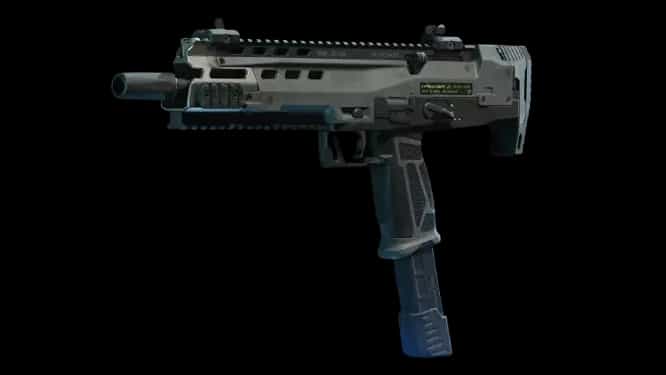
VST - Hip Fire Loadout by Klaw
MODS
GUIDE
Best VST Loadout in Warzone: Close-Range SMG Build
The VST is built for players who want to stay on the front foot. Current Warzone loadout trackers describe it as a fast-firing, highly mobile SMG with excellent close-range potential, but also note recoil and rapid ammunition consumption as drawbacks. This setup leans into the weapon’s natural strengths rather than trying to turn it into a miniature assault rifle: quick movement, fast reactions, reliable pressure inside buildings, and enough magazine capacity to keep fighting when a second opponent appears. For aggressive Resurgence players or Battle Royale users who need a compact secondary beside a longer-range primary, this is a very convincing direction.
Best Loadout
This configuration is designed around speed, close-range control, and sustained pressure. The exact combination of the 9.7" Enmity Barrel, Hawker Hybrid .45, Avarice Extended MAG II, EAM ScatterLine Laser, and Suffuse Tactical Pad is also listed by current Warzone loadout sources as a close-range VST setup.
| Attachment Slot | Selected Attachment |
|---|---|
| Barrel | 9.7" Enmity Barrel |
| Muzzle | Hawker Hybrid .45 |
| Magazine | Avarice Extended MAG II |
| Laser | EAM ScatterLine Laser |
| Stock | Suffuse Tactical Pad |
Attachment Analysis
What makes this VST build interesting is that every slot pushes toward the same type of fight. The short 9.7" Enmity Barrel keeps the configuration compact, while the Hawker Hybrid .45, EAM ScatterLine Laser, and Suffuse Tactical Pad support a more reactive style than a traditional recoil-focused setup. The result is a VST that feels happiest when you are moving through doors, stairwells, roof access points, and other spaces where the first accurate burst matters more than perfect long-range stability. Sources using this attachment combination frame it around close-range handling and mobility rather than extended-distance precision.
The Avarice Extended MAG II gives the rest of the build room to breathe. A fast-firing SMG can burn through ammunition quickly, so magazine depth matters when a gunfight turns into a two- or three-player exchange. Instead of building solely for one lightning-fast elimination, this setup gives you more freedom to finish one opponent, snap to another angle, and continue firing without immediately entering a reload. That is particularly useful in Resurgence, where compact spaces and repeated squad pushes often create messy engagements rather than clean one-on-ones.
There is still a trade-off. This is not the VST configuration I would choose for repeatedly challenging assault rifles across long streets or open hillsides. The build favors mobility, hip-fire confidence, and close-range handling over the mentality of a low-recoil beam. That gives it a clear identity: it is a pressure weapon, not a universal primary. Pair it with a dependable long-range rifle, LMG, or sniper-support weapon and let the VST stay in the distances where its fire rate and movement are most threatening.
Gameplay Tips
If I am carrying this VST, I want to manufacture short fights. Picture a squad holding the upper floor of a building while you approach from the opposite roof. I would not stand on the ledge trading bullets through a window. I would use cover to shorten the gap, get close enough that the VST’s handling matters, then enter from an angle that forces the defender to react. The gun rewards that decision: reduce the distance first, shoot second.
The ScatterLine Laser makes me more comfortable when an enemy suddenly appears inside a room or rounds a corner during a chase. I would not obsess over reaching a perfectly settled ADS picture before firing. In those moments, getting bullets out immediately and controlling the first half-second of the fight is more valuable. Against a player strafing across a doorway, keep your own movement alive rather than planting your feet and tracking as though you were holding an assault rifle.
One situation where I would resist the temptation to chase is a cracked enemy escaping across open ground. The VST can make aggressive players feel as if every damaged target must be finished immediately, but following someone into a long exposed lane can flip the advantage. I would cut the angle, force them toward cover, or switch to my longer-range weapon. The build works because it lets you dictate close engagements; giving that up for one desperate finish is rarely worth it.
In Resurgence, I would be more willing to keep the VST out during rotations through dense POIs because another fight can begin almost instantly. The extended magazine is especially useful after a first elimination when a teammate swings the doorway before you have reset. In Battle Royale, I would be stricter. If the circle pulls through exposed terrain, the VST stays secondary until I reach buildings, rocks, vehicles, or other cover that lets me close distance safely.
A small habit matters with this gun: do not reload automatically after every kill. With the extended magazine, check what is happening around you first. If footsteps are already on the stairs or a teammate is calling another enemy in the next room, keeping the remaining rounds ready can be safer than starting a reload because muscle memory told you to top off.
Conclusion
This VST setup succeeds because it commits to one job instead of pretending to solve every range. The 9.7" Enmity Barrel, Hawker Hybrid .45, Avarice Extended MAG II, EAM ScatterLine Laser, and Suffuse Tactical Pad create an aggressive SMG configuration centered on mobility, quick reactions, and enough ammunition to survive crowded fights. It suits players who like buildings, rapid repositions, and forcing opponents to react before they can settle into their own shots.
Give the build a few matches and pay attention to the fights you choose rather than only the kills you get. The VST becomes far more convincing once you stop asking it to win every duel and start using movement, cover, and timing to make sure the duel happens on its terms.
PERKS & EQUIPMENT
- Mountaineer
- Sprinter
- Tempered
Equipment
- LethalSemtex
- TacticalStim Shot